rome · silversea
Rome and Silversea Day 11
A day in Portimão and Silves, Portugal
- Start of day: Portimão, Portugal
- End of day: Heading to Lisbon (final night aboard)
Portimão, today’s stop, is a sun-washed port city on Portugal’s Algarve coast, set where the Arade River meets the Atlantic.

A short way upriver sits Silves, once the splendid capital of the Moorish Algarve – a topic we’d spend the morning learning about on our first of two shore excursions.
Silves


We made our way into town through the Mercado Municipal de Silves, the covered municipal market. It’s a bright, airy hall under a pitched glass-and-timber roof, ringed with whitewashed arches and lined with stalls of fish, fruit, and local goods.


We also visited the town’s archaeology museum, which is built around a striking centerpiece: a deep, stone-lined Moorish well-cistern some 800 years old and nearly 18 meters deep.1 The galleries arranged around it trace Silves through its many layers – Phoenician2, Roman, and Moorish – back to the days when this quiet hill town was a thriving Islamic capital.


From the museum we walked up through town to the cathedral, stopping briefly, and then on to the castle. The Castelo de Silves is the best-preserved Moorish castle in Portugal and the largest in the Algarve. It’s built from the local red sandstone, which gives the walls their reddish color, and goes back to the centuries of Moorish rule, when Silves was the regional capital.

View this reel on Instagram
Algarve caves
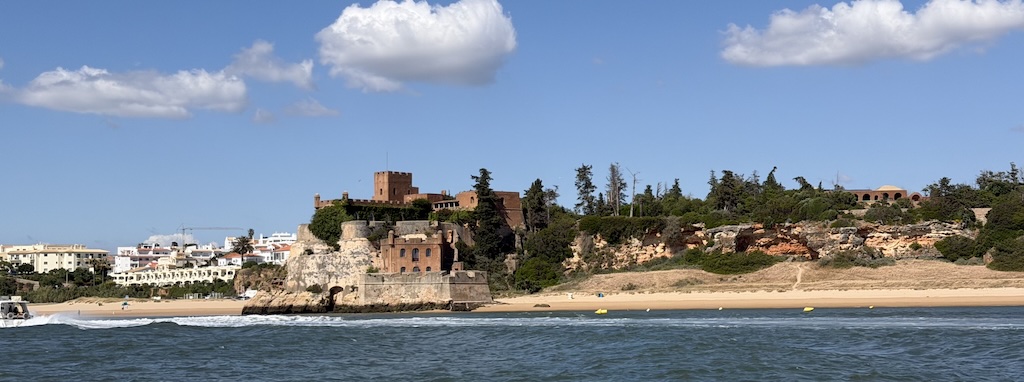
In the afternoon I did a RIB tour of the sea caves along the Algarve coast. The whole stretch is golden limestone that the ocean has carved into arches, sea stacks, caves, and little beaches you can only reach by water. The boat took us right inside several of them, including the famous Benagil cave east of Portimão, where part of the roof has collapsed into a big round skylight (people call it the “eye to heaven”), letting sunlight down onto the beach inside.


The last night
Somehow I made it through the day without getting sunburned!
As this was our last evening onboard, we again dined as a group at the S.A.L.T. restaurant, the same place we started the voyage.


Footnotes:
-
The stairs in the foreground wrap around the outside of the well. Visitors can descend a few meters and peer through one of the windows into the well. There are several other windows around the well at varying depths, so that water remains accessible. ↩